Dear Parishioners:
Friday night, we celebrated the Our Lady of Mercy 8th Grade Graduation Ceremony. Congratulations to the Class of 2025 and to all those graduating from school this year. Pray that they continue to grow in faith, hope, and charity. As St. Catherine of Siena said, “Be who God meant you to be, and you will set the world on fire.”

Christ with the Eucharist (or Christ with the Host and Chalice) by Vicent Macip (also known as Vicente Juan Masip, c. 1475–1550
Today, we celebrate the solemn feast of the Most Holy Body and Blood of Christ. Often called Corpus Christi, it is three feasts in one: the feast of the Eucharistic sacrifice, the feast of the Sacrament of the Eucharist, and the feast of the Real Presence of Jesus in this Sacrament. Corpus Christi is a doctrinal feast established for us to give God collective thanks for Christ’s abiding presence with us in the Eucharist and to honor Him there. It is meant to teach us to better appreciate and make use of the great gift of the Holy Eucharist, both as a Sacrament and as a sacrifice.
Although we celebrate the institution of the Holy Eucharist on Holy Thursday, the Church emphasizes its importance with a special feast called “Corpus Christi.” Today's celebration of the Body and Blood of the Lord originated in the Diocese of Liege in 1246 as the feast of Corpus Christi. Pope Urban IV officially instituted the Feast of Corpus Christi for the entire Catholic Church on August 11, 1264. It was established to publicly celebrate the Real Presence of Jesus Christ in the Eucharist.
In the reforms of Vatican II, Corpus Christi was joined with the feast of the Precious Blood (July 1) to become the Solemnity of the Body and Blood of the Lord. We celebrate today Christ's gift to us of the Eucharist, the source and summit of our life together as the Church.
Our belief in this Real Presence of Jesus in the Holy Eucharist derives from the literal interpretation of the promise of Christ to give us his Body and Blood for our spiritual food and drink, as found in St. John's Gospel, Chapter 6, and also in the four independent accounts of the fulfillment of this promise at the Last Supper (Mt 26; Mk 14; Lk 22; 1 Cor 11).
Theologians explain the Real Presence through a process called transubstantiation: the entire substance of bread and wine is changed into the entire substance of the risen, living, and glorified Body and Blood of Christ, retaining only the “accidents” (taste, color, shape) of bread and wine.
The Council of Trent declared that we must publicly honor Our Lord Jesus Christ in the Holy Eucharist, so that those who observe the Catholic faith in the Most Holy Eucharist might be attracted to the Eucharistic Lord and believe in the Divinity of Our Lord Jesus Christ, present in this great Sacrament.
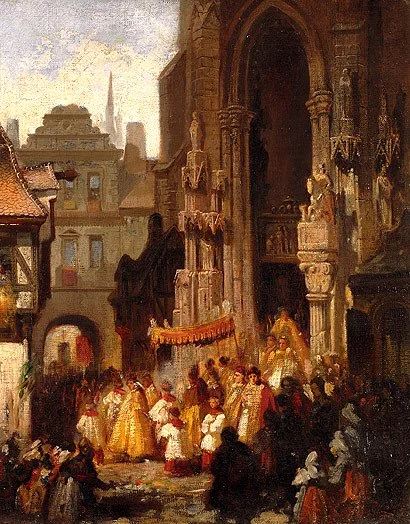
Corpus Christi Procession by Carl Emil Doepler (1824-1905)
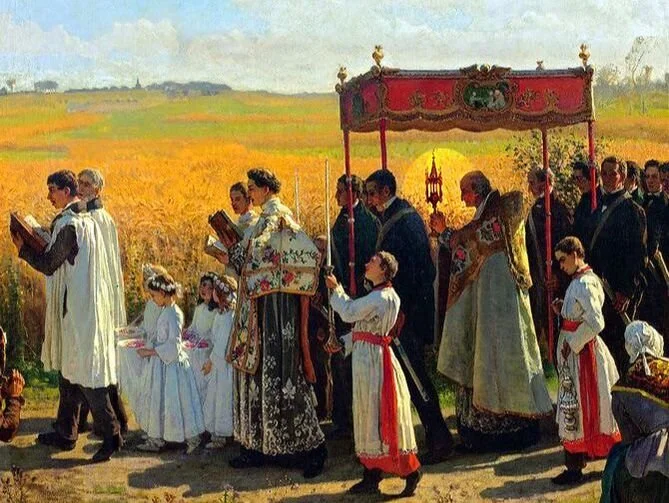
So I invite you to join us as we process with the Eucharist following the 10:30 am Mass. We will carry our Eucharistic Lord to Mercy Park, and there, the Benediction of the Blessed Sacrament will be offered.
In his encyclical Ecclesia de Eucharistia, Saint Pope John Paul II said: “The devout participation of the faithful in the Eucharistic procession on the Solemnity of the Body and Blood of Christ is a grace from the Lord which yearly brings joy to those who take part in it. In the humble signs of bread and wine, changed into the body and blood, Christ walks beside us as our strength and our food for the journey, and he enables us to become, for everyone, witnesses of hope.”

"La messa al campo,” by Emilio Rizzi in 1938
As we celebrate the Solemnity of Corpus Christi, we might reflect on our own appreciation of the Eucharist. We are blessed at OLM to have two priests and many Masses offered. Our Church is open all day for prayer before Christ, who is present in the tabernacle. We have frequent periods of Eucharistic Adoration when we can truly adore the Lord, truly present in the Blessed Sacrament. Do we avail ourselves of these blessed opportunities? Do we take them for granted?
We should also ask if we actively participate in the Mass? Do we sing and recite the prayers aloud? Are we dressed appropriately for Mass? Have we made the Eucharistic Fast? Do we arrive on time and stay until the end? Do we worthily receive Communion? Do we act as if we are in the real presence of Our Lord and Savior, Jesus Christ? G.K. Chesterton famously said, “The Mass is very long and tiresome unless one loves God.” Be well. Do good. God bless.